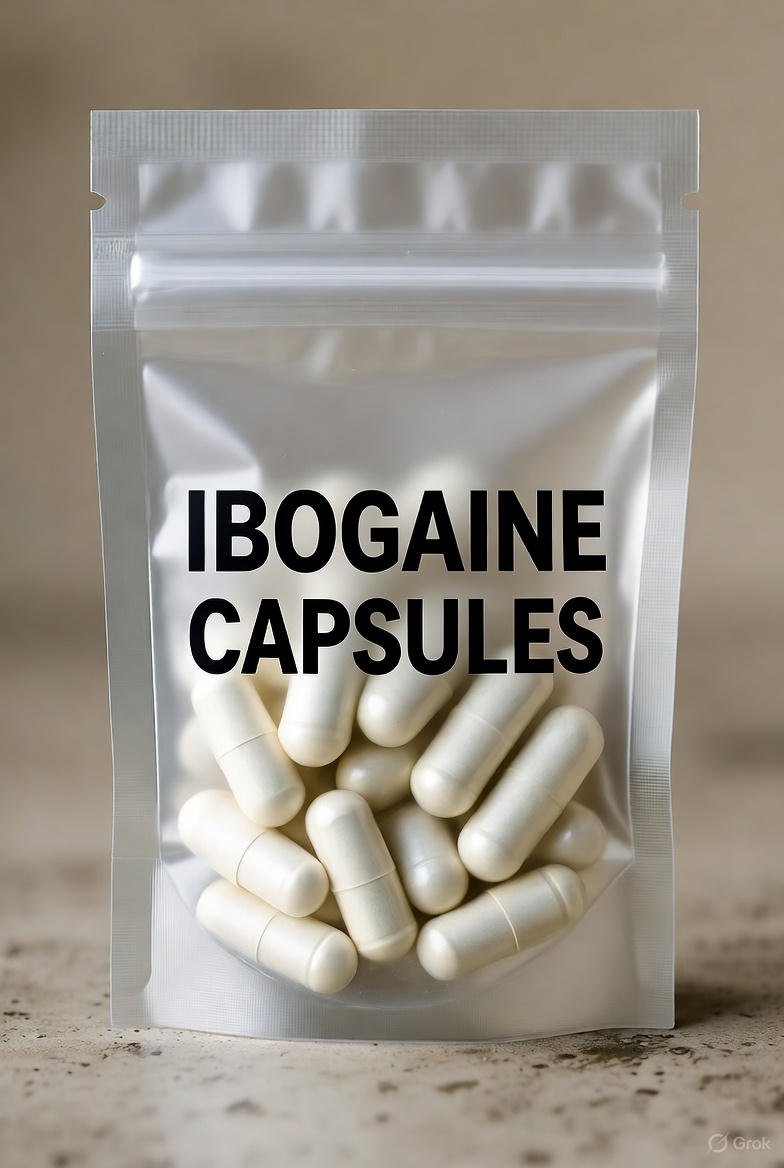

Ibogaine capsules represent a modern, precisely measured delivery system for the powerful alkaloid extracted from the Tabernanthe iboga shrub. Historically, practitioners used raw root bark in West African Bwiti ceremonies; however, today’s clinical landscape favors encapsulated Ibogaine HCl or Total Alkaloid (TA) extracts. These capsules allow for standardized dosing, which is essential given the compound’s intense physiological effects. Researchers primarily utilize Ibogaine capsules for their unparalleled ability to interrupt opioid addiction and facilitate deep psychological “resets.” By choosing capsules over raw bark, users bypass the gritty texture and extreme bitterness while ensuring they receive a specific milligram count. Ultimately, this format bridges the gap between ancient botanical wisdom and 21st-century medical rigor.
What are Ibogaine Capsules ?
Ibogaine capsules contain the isolated active compounds of the iboga plant, specifically formulated for oral consumption. Typically, these capsules feature Ibogaine Hydrochloride (HCl)—a highly purified white crystalline powder—or Total Alkaloid (TA) extract, which appears as a dark brown powder containing a broader spectrum of root bark compounds.
-
Specs & Technical Details: Standard capsules usually contain $100\text{mg}$ to $500\text{mg}$ of active material. The HCl version often reaches $95\%$ to $99\%$ purity, while TA extracts hover around $40\%$ to $60\%$ ibogaine. Because the molecule is quite stable, manufacturers use vegetarian or gelatin shells to protect the contents from oxidation. These technical standards ensure that researchers can calculate exact dosages based on a patient’s body weight, a critical factor for safety and efficacy.
What Do Ibogaine Capsules Feel Like ?
Taking Ibogaine capsules triggers a profound, multi-layered experience that differs significantly from “recreational” psychedelics. It generally unfolds in distinct movements.
-
The Visionary Stage: During the first $4$ to $8$ hours, users often encounter intense, “dream-like” internal visuals with their eyes closed. Many describe this as watching a “film” of their own life or ancestral history.
-
The Introspection Phase: After the visions subside, a long period of deep reflection begins. During this phase, the user feels a “gray-screen” effect where they process the earlier visions with extreme emotional detachment. This allows for an objective analysis of past traumas or behaviors, often leading to a profound sense of “mental decluttering.” Throughout both stages, a heavy physical sensation, or “ataxia,” makes movement difficult and reinforces the need for a stationary, meditative state.
What Does An Ibogaine Trip Feel Like ?
An Ibogaine trip feels less like a “hallucination” and more like a high-definition “waking dream” or “one-on-one therapy session with the subconscious.” Unlike the swirling colors of LSD, Ibogaine visuals are often coherent, narrative, and incredibly vivid. Physically, you might experience a buzzing or humming sound in the ears, accompanied by a heavy, vibrating sensation in the limbs. Furthermore, the experience feels intensely “sober” despite the visions; users remain remarkably lucid and able to navigate complex emotional memories without the typical “confusion” of other substances. Many participants report a feeling of “brain-resetting,” as if their neural pathways have been washed clean. It is a demanding, often grueling experience that feels more like a profound medical or spiritual surgery than a casual journey.
| Quantity | 20 Capsules, 50 Capsules, 100 Capsules, 1000 Capsules |
|---|
Be the first to review “Ibogaine Capsules”
Related products

IBOGAINE

IBOGAINE
IBOGAINE
Reviews
There are no reviews yet.